Skool Pricing 2026: $9 vs $99 — Which Plan Is Actually Cheaper?
Last checked: September 2026
Short answer: start with Hobby if you’re testing an idea or running a free community. Pro starts to make financial sense at roughly $1,268/month in paid transactions, even before you consider any other Pro benefits.
Skool currently has two main creator plans:
| Plan | Monthly price | Transaction fee |
|---|---|---|
| Hobby | $9 | 10% + $0.30 per transaction |
| Pro | $99 | 2.9% + $0.30 per transaction up to $899 |
For transactions above $900, Skool currently charges 3.9% + $0.30 on Pro.
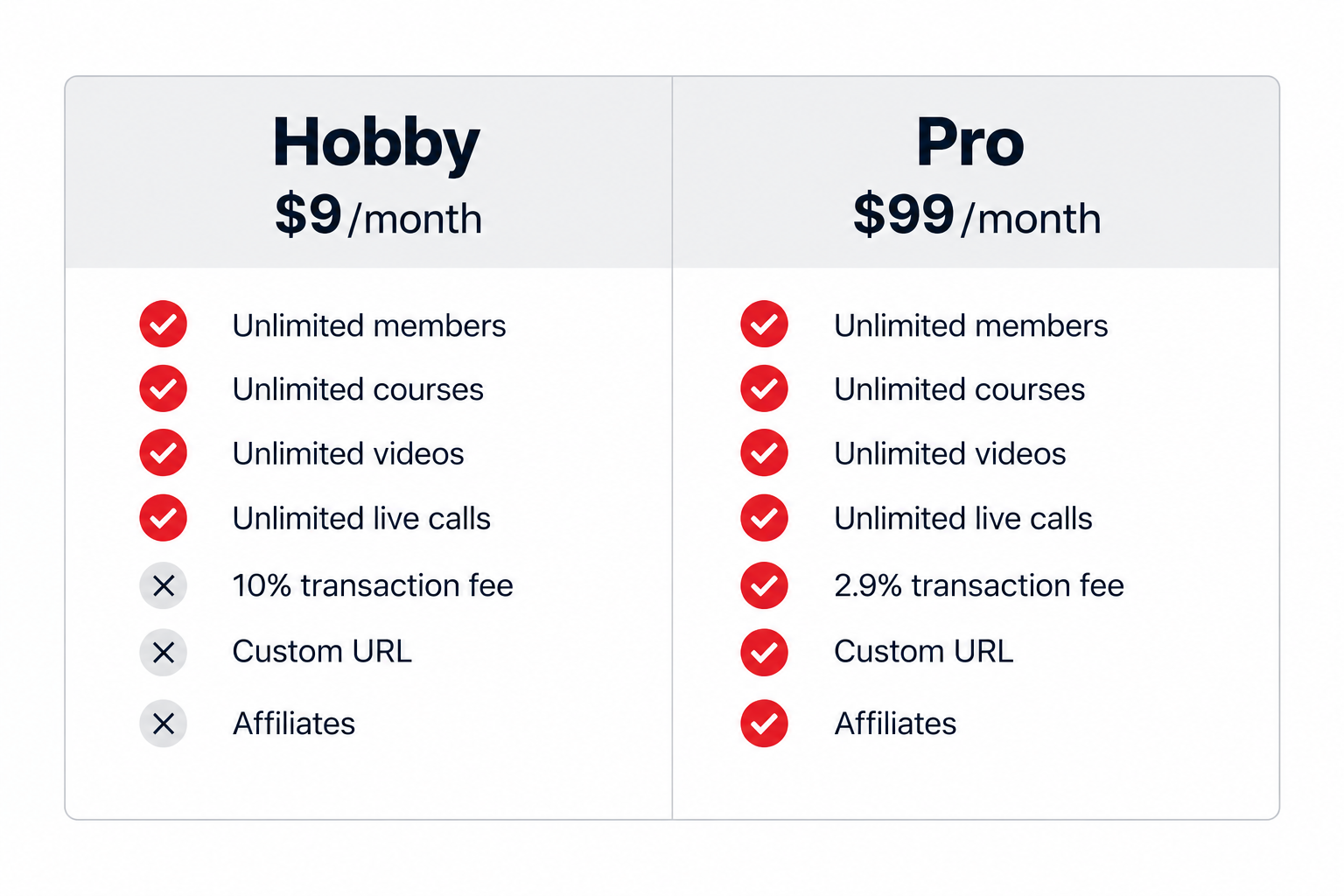
What do you get on both plans?
Skool currently lists the following on both Hobby and Pro:
- unlimited members
- unlimited courses
- unlimited videos
- unlimited live calls
So this isn’t really a case of the $9 plan being a crippled demo version.
You can build a real community on it.
The more interesting question is what happens once money starts coming through the community.
That’s where the fee difference matters.
The real difference: 10% vs 2.9%
The Hobby plan costs almost nothing each month.
But Skool takes a larger percentage of each transaction.
The Pro plan costs another $90 per month, but you keep more of each sale.
That means there is a point where the “expensive” plan actually becomes cheaper.
And it’s lower than you might expect.
When does Skool Pro become cheaper than Hobby?
For normal transactions under $900:
Hobby fee: 10%
Pro fee: 2.9%
Difference:
7.1%
The Pro subscription costs $90 more per month.
So:
$90 ÷ 7.1% = about $1,268
That means if your Skool is processing roughly $1,268 per month, the lower transaction fees on Pro have saved about enough to cover the additional subscription cost.
The fixed $0.30 transaction charge is on both plans, so it cancels out of this particular comparison.
Rough guide
| Monthly paid revenue | Hobby percentage fee | Pro percentage fee | Difference |
|---|---|---|---|
| $250 | $25.00 | $7.25 | $17.75 |
| $500 | $50.00 | $14.50 | $35.50 |
| $1,000 | $100.00 | $29.00 | $71.00 |
| $1,268 | $126.80 | $36.77 | ~$90.03 |
| $2,000 | $200.00 | $58.00 | $142.00 |
| $5,000 | $500.00 | $145.00 | $355.00 |
These figures show the percentage component only. The $0.30 per-transaction charge still applies on both plans.
So should you just start on Hobby?
For most brand-new communities, I would.
Especially if:
- you don’t yet know whether people will pay
- you’re running a free community
- you’re testing the idea
- you’re still getting your first members
- revenue is well below the break-even point
Paying $99 every month before you’ve proved the idea can make money doesn’t automatically make the community more serious.
Sometimes it just makes the experiment more expensive.
At $9, you can find out whether anyone actually wants what you’re building without much financial pressure.
When I’d move to Pro
The maths becomes pretty straightforward once you’re approaching that $1,268/month mark.
If you’re consistently processing more than that, I’d look seriously at Pro simply because of the transaction fees.
You may choose Pro earlier for other reasons.
And you may stay on Hobby longer if most of your community is free.
But if you’re comparing the two purely on subscription cost versus transaction fees, around $1,268/month is the useful number to remember.
What about a $29/month community?
This is where the maths becomes more tangible.
Say you charge $29/month.
On Hobby, the percentage fee is:
$2.90 per member
On Pro:
about $0.84 per member
The difference is roughly:
$2.06 per member, per month
You’d need about 44 paying members at $29/month to reach the same rough break-even point.
44 × $29 = $1,276/month
That’s very close to the $1,268 figure above.
What about a $99/month community?
At $99/month:
Hobby percentage fee:
$9.90
Pro percentage fee:
about $2.87
Difference:
about $7.03 per member
At around 13 paying members, you’re already around the point where the Pro fee savings can cover the extra $90 monthly subscription.
Again, the $0.30 fee applies to both, so it doesn’t change this comparison.
What if your community is free?
Then the fee maths barely matters.
If nobody is paying through Skool, there are no payment transaction fees to compare.
That makes Hobby particularly attractive for someone who wants to:
- build an audience first
- run a free community
- test engagement
- validate the idea
- add a paid offer later
You can always upgrade once the economics change.
What if you sell expensive offers?
This is where the calculation needs a little more care.
Skool currently says Pro charges:
- 2.9% + $0.30 for transactions up to $899
- 3.9% + $0.30 for transactions above $900
Hobby remains 10% + $0.30.
So if you sell a $1,000 course or membership payment, the Pro advantage is still substantial, but the fee difference is no longer 7.1 percentage points.
It becomes 6.1 percentage points for those higher-value transactions.
For most ordinary monthly memberships, though, the 2.9% comparison is the relevant one.
Does Skool have annual pricing?
Skool’s current pricing page shows a Yearly option and advertises “2 months free” compared with monthly billing.
Because pricing interfaces can change, I’d check the live Skool pricing page before paying annually rather than relying on an old article quoting an effective monthly figure.
That’s one of the reasons I date these pages.
Hobby vs Pro: my simple rule
I wouldn’t overthink this.
Choose Hobby if:
- you’re new
- you’re testing an idea
- your community is free
- revenue is still low
- you’d rather keep fixed costs tiny
Look seriously at Pro if:
- your paid revenue is approaching $1,268/month
- transaction fees are becoming meaningful
- you’re already confident the community has demand
- other Pro benefits matter to how you operate
For a brand-new idea, I think $9 is one of Skool’s strongest advantages.
You can test the actual community before spending much money on the platform.
My recommendation
If I were starting another Skool from scratch today, I’d start on Hobby unless I already knew I was going to process enough revenue to justify Pro.
I wouldn’t pay $99 just because it feels more “professional”.
I’d make the community prove it needs the upgrade.
Then, once the maths says Pro is cheaper, the decision gets rather easy.
One thing to remember
The platform fee is not usually the hardest part of building a community.
The much bigger question is whether people will join, pay and come back.
A cheap platform with nobody using it is still expensive.
A $99 platform supporting a healthy paid community can be very cheap.